
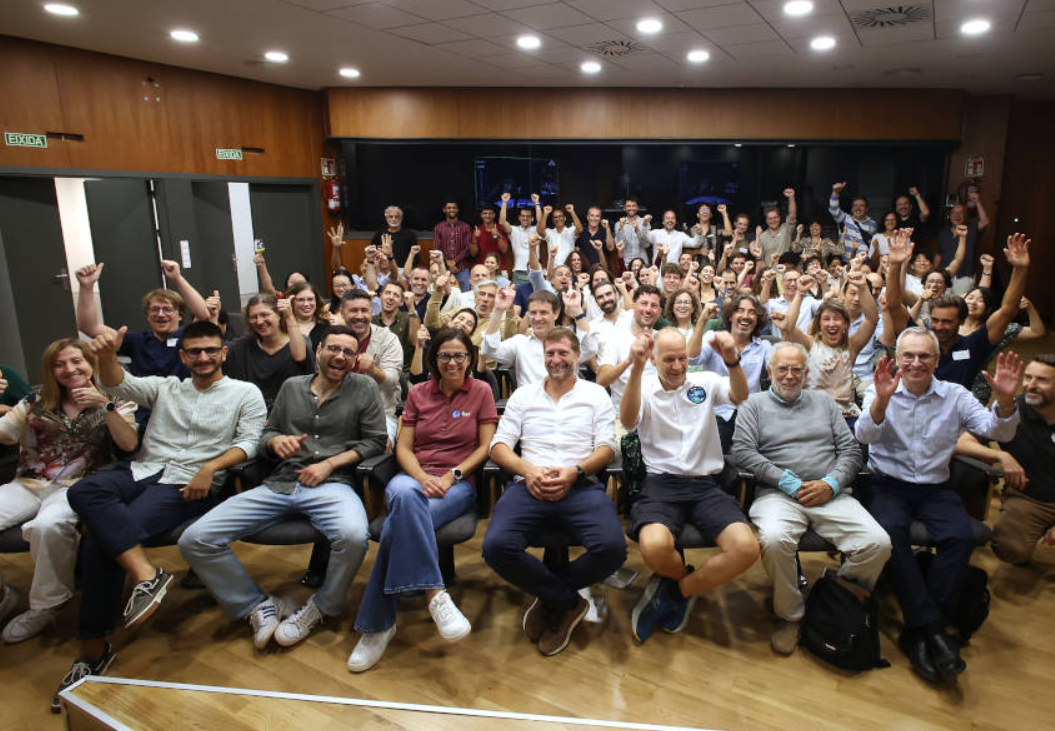
The leader of the FLuorescence EXplorer (FLEX) satellite mission and director of the Earth Observation Laboratory at the University of Valencia followed the operation from the headquarters of the ADEIT Foundation of the UV, together with members of his team, at a commemorative event attended by almost one hundred people from the international scientific community who have contributed to the project, representatives of the European Space Agency (ESA) and partners from the European space sector.
The anticipation and nerves were inevitable from early in the evening because, as Moreno acknowledged, “every launch involves a significant risk and there are many things that can go wrong when launching a rocket into space”. However, the first result was a complete success. “Getting through the launch and having the satellite already in orbit is a great relief and brings a sense of joy and peace of mind at having reached this milestone”, said the Valencian scientist, who described the moment as “the culmination of a great deal of effort by many people and a major celebration for the entire UV team. We are all very excited”.
The mission's initial objectives, which has more than two decades of research work behind it, are to gather data for application to studies of climate change, agriculture, forests and vegetation-cover dynamics. The aim is to determine in advance how capable the planet's green mantle is of responding to extreme events, as well as to optimise agricultural yields in order to contribute to ending hunger around the world.