
CMCC Lectures
13 May 2026, 12:00 CEST
To join the Lecture, register here
Join Sandy P. Harrison’s Lecture to explore why wildfires matter more than ever in a changing climate. Learn how science is redefining our understanding through the perspective of a leading international expert in wildfire science and climate–vegetation interactions, who will share insights drawn from decades of influential research at the forefront of Earth System science. Explore innovative modelling approaches that push beyond current limits in predicting wildfire behaviour and engage in the discussion!
Wildfires are pervasive and an integral part of the Earth System, essentials for maintaining the functioning and biodiversity of many ecosystems. Changes driven by wildfires in vegetation and landscape properties also have important feedback on climate by modulating water and energy exchanges and the carbon cycle.
The ability to model vegetation-fire interactions is thus extremely important from an Earth System perspective. Current global models, used to predict how wildfires behave in a changing climate, capture some aspects of wildfire behaviour, but struggle at simulating the timing and length of the fire season, interannual variability in wildfire occurrence and extreme fires. These limitations are largely due to poor observational constraints of the processes that control wildfires.
Recent research has improved our understanding of the environmental factors controlling wildfires occurrence and behaviour.
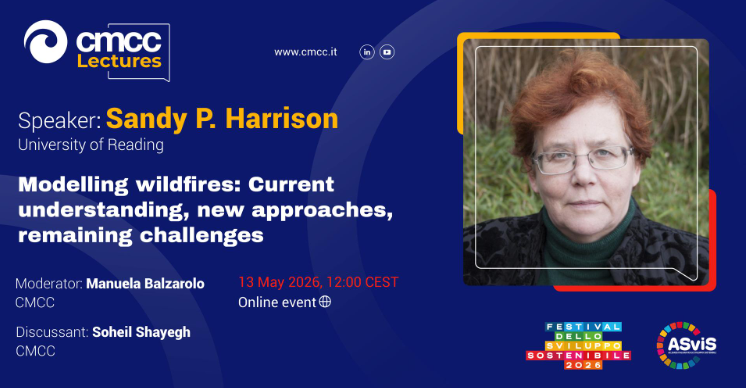
In this CMCC Lecture, Sandy P. Harrison, Professor of Global Palaeoclimates and Biogeochemical Cycles at the University of Reading and CMCC Bassi Fellow, will showcase new approaches to modelling wildfires, including the development and application of empirical data-driven models and machine-learning to simulate wildfires, the use of large ensemble modelling to capture extreme behaviour and uncertainty, and the application of eco-evolutionary optimality theory to provide a more robust coupling between vegetation and wildfire.
Prof. Harrison will also show why it is important to test these models under radically different climate states in the geologic past to evaluate how well they can be expected to simulate the response to future climate change.
Speaker: Sandy P. Harrison, Professor of Global Palaeoclimates and Biogeochemical Cycles, University of Reading
Discussant: Soheil Shayegh, CMCC
Moderator: Manuela Balzarolo, CMCC